
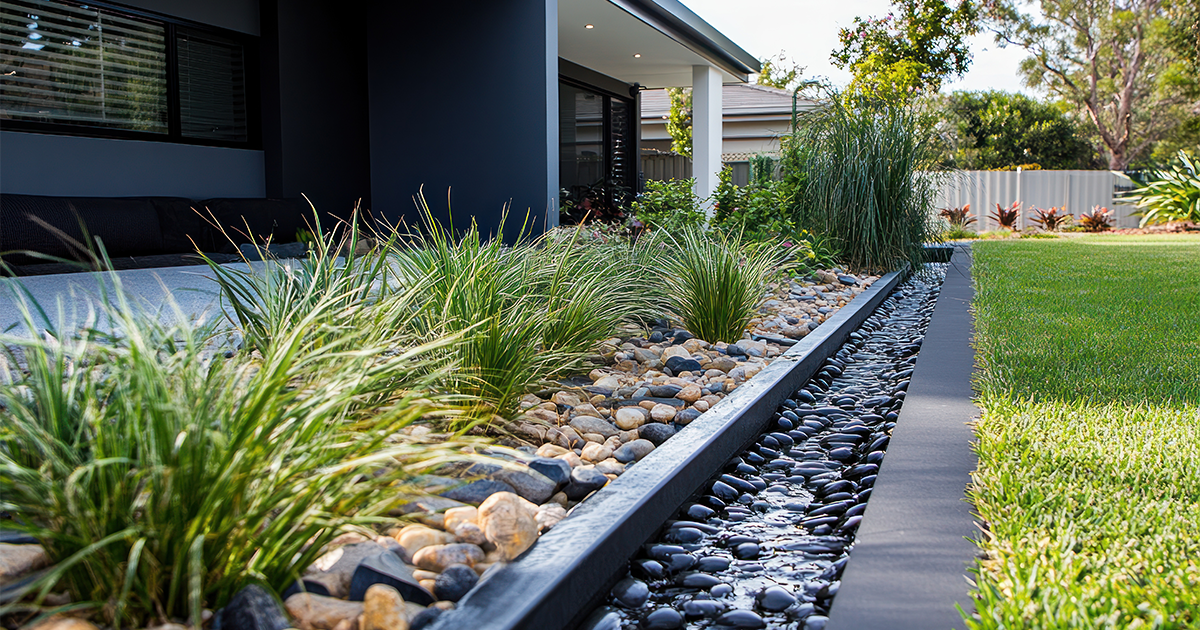
Nobody talks about grading. Homeowners talk about their new patio, their retaining wall, their landscaping. They share photos of the finished product. But grading, the shaping of the land that makes all of those things work, almost never comes up until something goes wrong.
That is exactly the problem. Grading is the invisible foundation of every outdoor project. When it is done correctly, nobody notices it. Everything drains, nothing shifts, the lawn grows evenly, the patio stays level. When it is wrong, every problem that follows gets blamed on something else: the pavers, the plants, the retaining wall. The real issue was always the grade.
What Grading Actually Is
Grading is the process of shaping the surface of the land to control how water moves across and through it. Every property has a grade, whether intentional or not. The question is whether that grade is working for the property or against it.
Positive grade means the land slopes away from structures and toward appropriate drainage outlets. This is what you want. Negative grade means the land slopes toward the house, toward a retaining wall, or into a low spot with nowhere to drain. This is what creates the warning signs of a drainage problem that show up as pooling water, wet basements, dying grass patches, and eroding soil.
Why Grading Gets Overlooked
Grading is invisible. Once the topsoil and lawn are down, or the hardscaping is installed, you cannot see what the grade is doing. It does its job, good or bad, completely out of sight. That invisibility means it tends to get treated as a secondary concern rather than the primary one it actually is.
It also gets overlooked because it looks simple. Moving dirt around sounds like basic work. In reality, establishing proper grade across a residential property requires understanding drainage patterns, soil behaviour, the relationship between the property and its neighbours, the position of utilities and structures, and the end state the project needs to achieve. Done poorly, the results are subtle at first and catastrophic over time.
Grading also degrades without anyone doing anything wrong. Soil settles naturally over years. Tree roots shift the ground. Foot traffic compacts certain areas more than others. A property that graded perfectly when it was built may have developed significant grading issues over a decade of normal use and settling.
What Happens When Grading Is Wrong
Water pools in the yard and does not drain within hours of a normal rainfall
Moisture seeps into basements and crawl spaces after rain events
Patios and walkways shift and settle unevenly as the soil beneath them moves
Retaining walls experience increased hydrostatic pressure and eventually fail
Lawns develop chronically wet zones where grass struggles to establish
Erosion strips topsoil from sloped areas and deposits sediment in low spots
Foundation walls develop cracks as water pressure cycles with freeze-thaw
Every one of these problems has grading as a root cause or contributing factor. They are also all significantly more expensive to fix after the fact than they would have been to prevent with proper grading at the start. This is the core argument we make in our post on how residential excavation sets the foundation for every outdoor project. The foundation is the grade. Everything built on a properly graded site starts with the right conditions to succeed.
Grading Standards That Matter in Ontario
There are practical grading standards that apply to residential properties in Ontario, based on building code requirements and long-established construction practice:
Foundation drainage grade: Soil immediately surrounding a home's foundation should slope away at a minimum of two percent over the first ten feet, meaning at least 2.5 centimetres of fall per metre.
Patio and hardscaping grade: Paved outdoor surfaces should slope away from the home at approximately one to two percent. Completely flat surfaces hold water and accelerate freeze-thaw damage.
Lawn and landscape grade: General lawn areas benefit from a gentle positive slope toward drainage outlets. Areas with slopes steeper than 3:1 require additional erosion control measures.
Drainage outlet positioning: Water directed away from one structure cannot simply be directed toward another. Grading needs to account for the full property and, where relevant, the relationship to neighbouring properties.
Grading on Sloped and Challenging Properties
On sloped properties, grading becomes more complex and more consequential. A slope without proper grading management will always tend toward erosion, pooling at the base, and instability in any structures built on or near it. Our post on how grading and retaining walls can transform a sloped property covers how terracing and retaining walls work together with grading to make sloped sites fully functional.
Soil type also plays a significant role in how grading behaves over time. Clay-heavy soils common in parts of Simcoe County shift and heave with moisture changes in ways that sandy soils do not. Understanding your site's soil profile, as we cover in our post on soil types in Simcoe County, is part of designing grading that holds its intended grade over time rather than drifting back toward problem conditions.
We serve homeowners and property owners across Barrie, Simcoe County, Midland, Oro-Medonte, Muskoka, Vaughan, Richmond Hill, and the Greater Toronto Area.
Noticing drainage issues, wet spots, or shifting hardscaping on your property? The grade is usually the first place to look. Contact Superior Property Group for a free site assessment and we will tell you exactly what is happening below the surface.
Frequently Asked Questions
How do I know if my property has a grading problem? Walk the property after a normal rainfall. Anywhere water pools for more than a few hours, or anywhere you notice soil eroding, is a candidate. Water seeping into a basement is almost always a grading issue at the source.
How much does grading correction cost in Ontario? Scope varies widely. Minor re-grading around a foundation may be a relatively small job. Full property grading correction on a larger lot is a more significant excavation project. A site assessment is needed for an accurate estimate.
Will grading correction damage my existing landscaping? It depends on the scope. Targeted grading work can often be done with minimal disturbance to existing plantings. More extensive grade correction may require temporarily removing and replanting affected areas.
Does grading work need a permit in Simcoe County? Most residential grading correction does not require a building permit. However, if the work significantly alters drainage onto neighbouring properties or is in a regulated area near water, additional approvals may apply.
Superior Property Group | Simcoe County, Muskoka and the GTA | superiorpropertygroup.ca
